
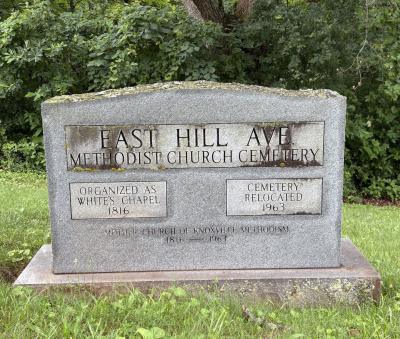
Have you ever heard of Knoxville’s Methodist Hill? Did you know an entire graveyard was dug up and relocated from the current location of the Women’s Basketball Hall of Fame? If not, please read about the history of East Hill Methodist Church.
On May 13, 1816, Hugh Lawson White deeded half an acre to John Winton, Thomas Wilkerson, John Manifee, Jesse Turbeville, John Haynie, Jeremiah King and John Sutherland Jr. to construct a Methodist Church. John Haynie would become the church’s first minister upon its completion the following year. Named White’s Chapel, after its benefactor, this was the first Methodist church in Knox County and the congregation worshipped in this small wooden chapel until they eventually outgrew it. In 1836, the congregation built a brick building on Church Street in downtown Knoxville where the Knoxville General Building stands, keeping the frame church building as a Sunday school.
In 1844, the Methodist church split over the issue of slavery, resulting in the Church Street congregation opting to side with the newly created Methodist Episcopal, South, which condoned slavery. During the 1840s and early 1850s the Sunday school and meeting house building hosted Black Methodist congregants to worship, although it is unclear if these worshippers were enslaved or free people of color. Even though the primary congregation moved downtown, this site was so associated with the Methodist church on which it sat, the hill became known as Methodist Hill and remained that until the mid-20th century.
By 1852, the cemetery was being used by locals as a potter’s field and burial place for enslaved people. The 1850s also saw the hill used for large speaking engagements such as informational lectures and political speeches. On July 14, 1859, competing speeches were delivered by ex-Whig candidate John Netherland and incumbent Democratic Governor Isham Harris.
Following the Civil War, in which the Church Street site was used as a hospital, the anti-slavery Methodists, led by Gov. William “Parson” Brownlow, organized a congregation and began construction on their own church building, right behind the Church Street location. This church, First Methodist Episcopal, was completed in May 1869.
Just three months later, in August, the first reports arose of the poor condition of the cemetery on Methodist Hill. Efforts were made to clean up the cemetery, but by 1873 disrepair and malodor once again arose. The chapel on Methodist Hill was replaced around 1886, however the newspapers do not make it clear if this is still the same building from 1816. Some articles differ whether the first chapel burned during the Civil War or in this 1880s event.
In June 1894, the city began widening Jefferson Street (later known as Rouser Street), which ran alongside Methodist Hill cemetery. However, during construction, they cut too deep into the hill and uncovered 5 or 6 graves, which toppled into the street. The church was awarded money from the city to repair the graveyard. Just months later, on November 28, 1894, the Methodist Hill Chapel burned to the ground due to a cracked brick heater in the basement. The money awarded by the city to repair the cemetery retaining wall was instead put toward building a new church building. This proved problematic for the neighborhood as freezes and rains over the seasons continuously caused new graves to crumble off the hill and into the street until a new rock wall could be built in July 1899.
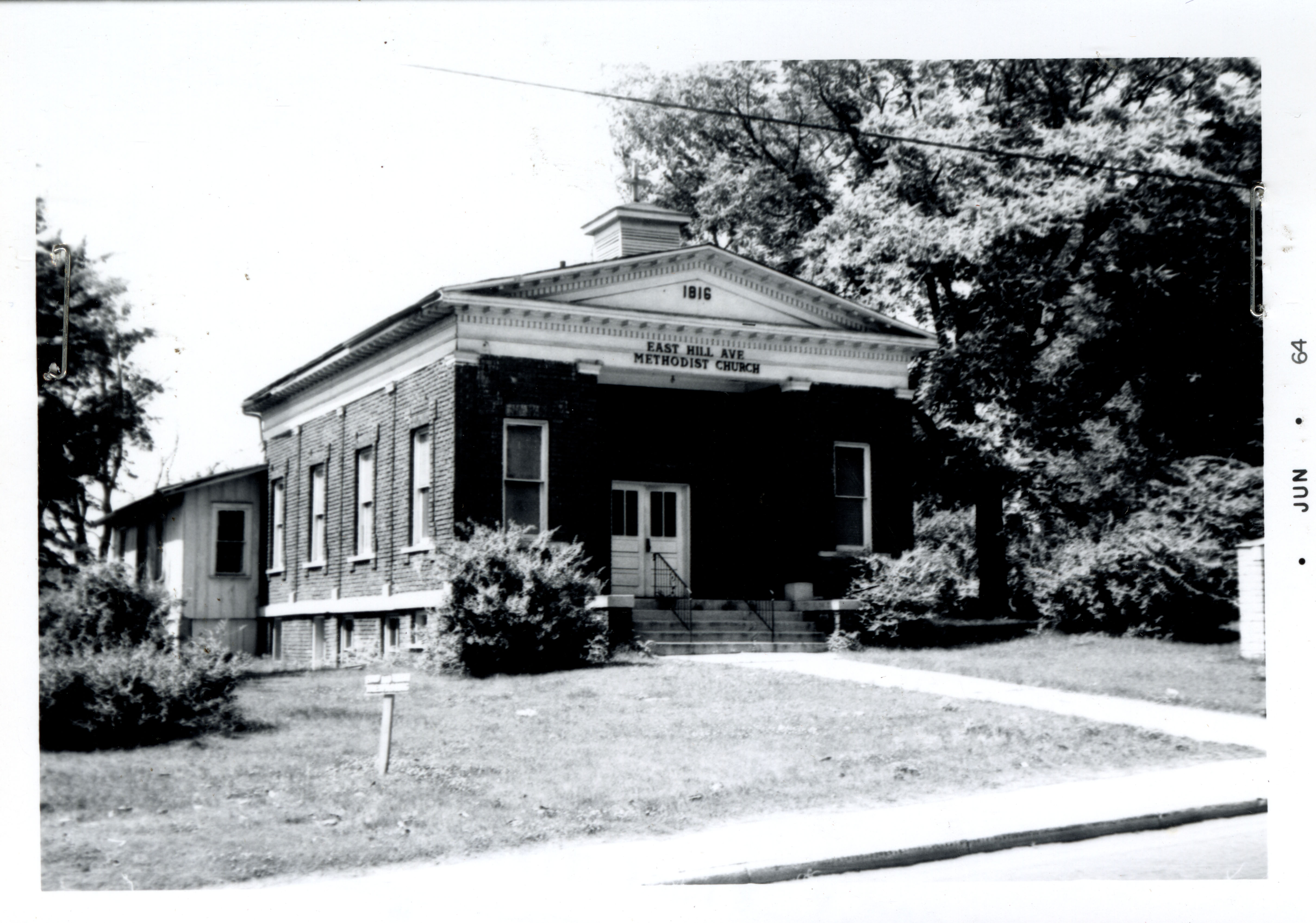
Efforts to rebuild the church building were put on hold following the fire and retaining wall fiasco, but, by 1901, benefit concerts and fundraisers picked up in an effort to reestablish a church on Methodist Hill. Firm plans to construct a new Methodist church were finally announced in the Knoxville Journal on January 21, 1910. The first services held in the newly constructed brick chapel were held on June 19, 1910. This new church was given the name East Hill Avenue Methodist Church.
This church operated until June 1963 when the Holston Conference voted to abandon the church due to dwindling attendance. The decision was probably precipitated by the fact that the church lay right in the middle of the Knoxville Housing Authority’s Mountain View Urban Renewal Project. On April 14, 1967, the church and KHA agreed to a sale price of $27,600 for the church and graveyard with $5,000 set aside to remove the suspected 15-25 graves in the cemetery. It was decided that Ed Berry of Berry Morticians would exhume the graves and eventually relocate them to Woodlawn Cemetery in South Knoxville. Mr. Berry began the operation by using a backhoe to remove the top layer of dirt, then hand shoveling remains into reburial containers. When all was said and done, Berry found at least 380 burials in this small graveyard including evidence of mass burials. The discovery of so many additional burials ballooned the cost of reburial from $5,000 to $73,500. The East Hill Methodist graveyard was successfully repositioned to a hill within Woodlawn, marked with only a single marker for the whole cemetery.
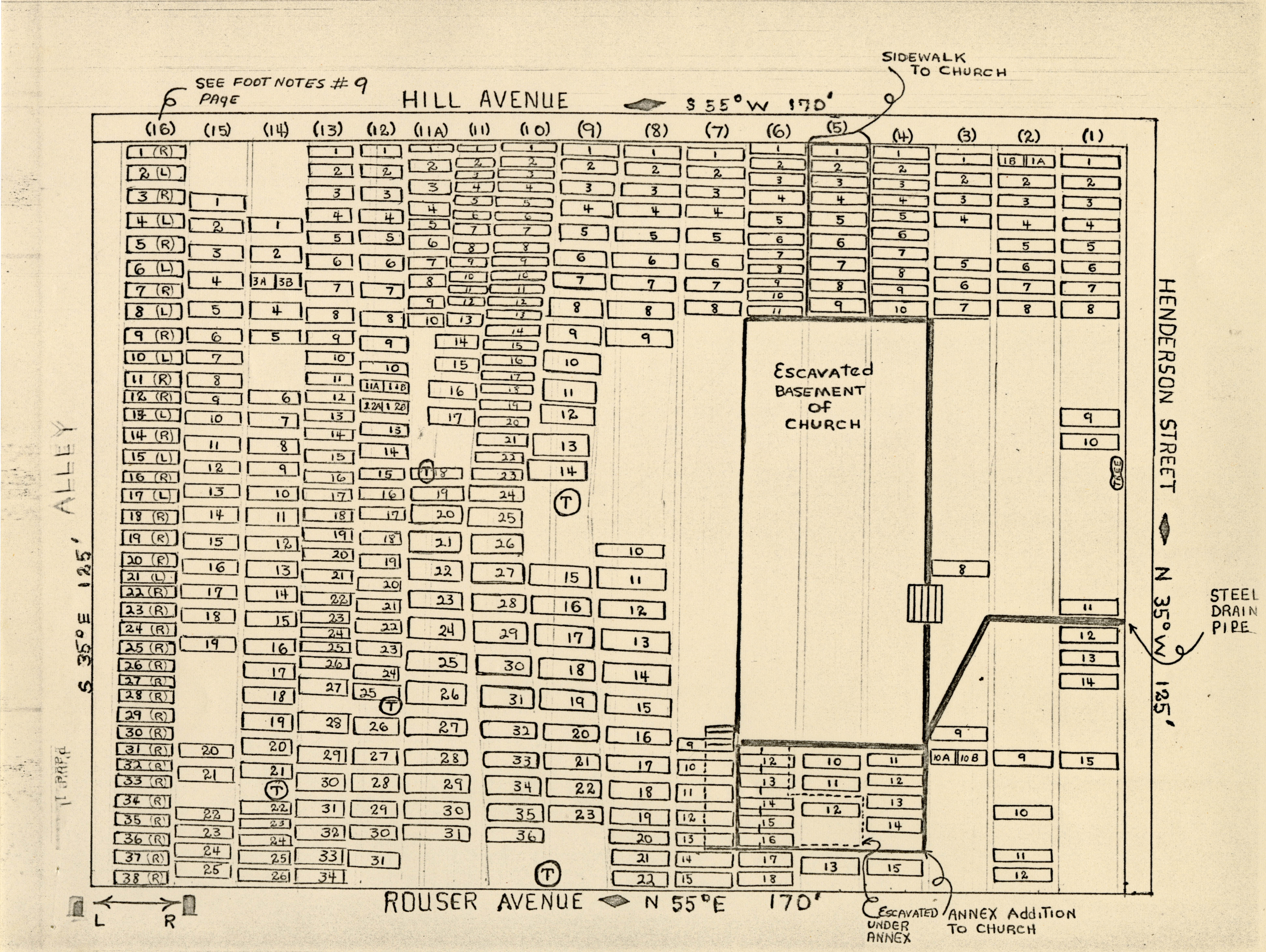
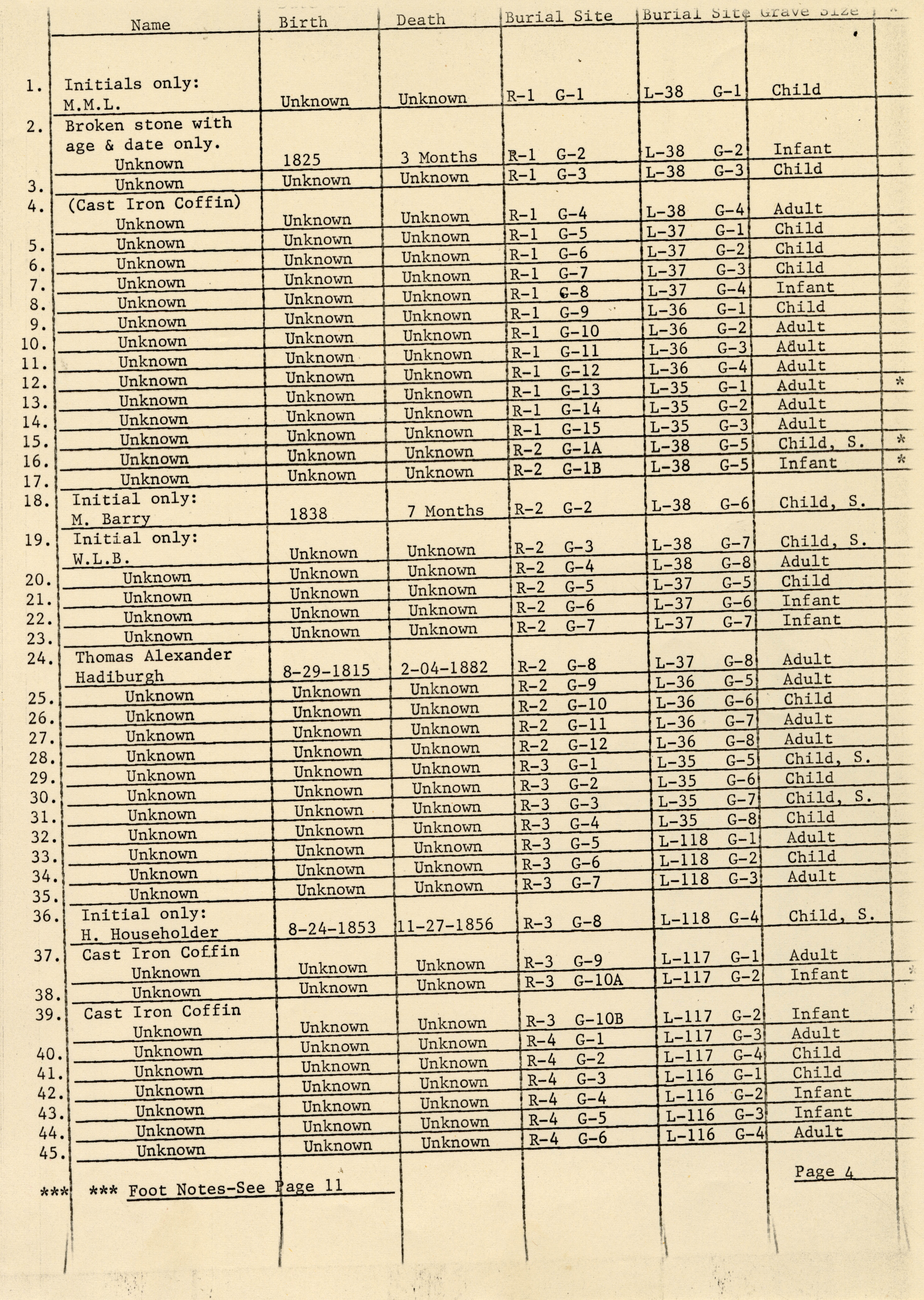
Below are the names of a few additional people buried in the East Hill Methodist Cemetery that do not appear in the official list created in 1967, but many more remain unidentified:
Rachel Burdwell Hill, 1827
Gabriel M. Rogers, died November 26, 1850
R. Park Miller, March 1861
? Dozier, August 1870
Nancy W. Seay Hill, June 1871
Mary Jane Wright, died April 14, 1876
Anderson Hill, May 1882
Cassandra Randall, May 23, 1898.
W. S. McTeer, January 18, 1907
Researched and written by Zachary Keith, Knox County Archives