
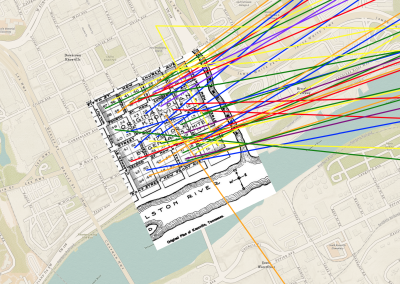
The Knoxville Origins StoryMap chronicles the founding of the city and traces participants in the 1791 Knoxville Land Lottery. Land lotteries were commonly used in frontier settlements to encourage growth and attract settlers. The lottery offered parcels within the newly surveyed town plan along the Tennessee River.
The land lottery is visualized by a plat map taken from Samuel G. Heiskell's book, Andrew Jackson and Early Tennessee History (1918).
From the Knoxville Gazette on Dec 17, 1791:
The Knoxville Gazette recounted the details of the Knoxville Land Lottery, which took place on October 3, 1791:
Articles of agreement made and concluded on this third day of October, 1791, by and between James White, proprietor of the land laid off for the town of Knoxville, of the one part, and John Adair, Paul Cunningham, and George McNutt, commissioners appointed in behalf of the purchasers of the lots in the town of Knoxville, of the other part, all of Hawkins County, and Territory of the United States of America South of the Ohio River, WITNESSETH that the said James White do bargain and sell to the subscribers for lots in the said town, 64 lots, each containing one-half acre square, reserving 8 lots which are not to be loted for.
The Lottery Winners:
Seventy-nine men drew numbers in the lottery, more than the actual number of available lots, as some partnered up and drew a single number together. Some of them would come to stay, settling on their lots. Others were just passing through and sold their lots soon after. Yet others were land speculators and drew in the lottery with the intent of selling their $8 lots all along. These men came from all over. Some of them were likely already in the Knoxville area in 1791, others came from upper East Tennessee counties, and still others came from out of state for their chance to obtain a piece of this new city.
By tracing their paths to Knoxville, certain trends emerge, such as former North Carolina Revolutionary War soldiers coming west to claim lands warranted to them for their service; men emigrating from Ireland to America and ultimately to Tennessee; and settlers traveling southwest on the Great Wagon Road. There are even some outliers, such as George Farragut, who was born on the Mediterranean island of Menorca and spent time in New Orleans.
How to Explore StoryMaps: